
Ice shower routines
How Long Should an Ice Shower Be?
Keep an ice shower brief, especially when you are new to cold. Ordinary cold-shower studies have tested 30–90-second finishes, but there is no established ideal duration for a refrigerated ice shower. Choose the time alongside temperature, coverage and your response, and finish sooner if you feel unwell.
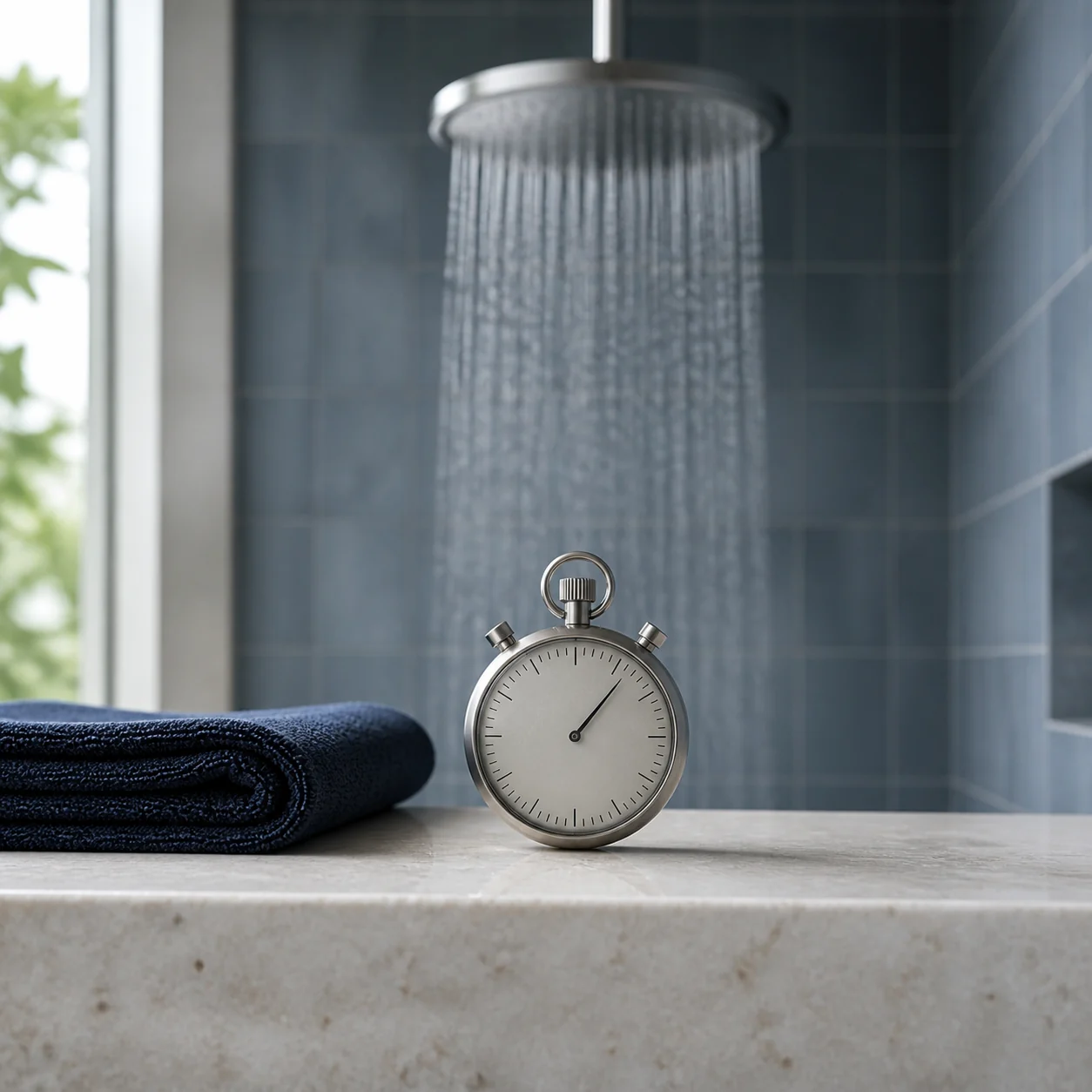
At a glance
Keep it brief
30–90-second cold finishes have been studied in ordinary showers. They are not a prescription for refrigerated water.
Time needs context
Temperature and the areas under the spray matter alongside the seconds on the clock.
You can finish early
Use a timer to keep track of exposure. Do not treat its final beep as something you have to reach.
In this guide
Where do common cold-shower timings come from?
A recommendation of thirty seconds, one minute or three minutes needs context. It might describe a cold finish after washing, a study protocol or general advice for an ordinary shower. Those are not interchangeable instructions for actively chilled water.
Here, an ice shower means a system that actively cools its water. Depending on the setting, it may deliver water much colder than the tap-water shower a recommendation describes.
These timings explain the advice you may encounter. They are not a progression plan. Scroll across on smaller screens.
| Time or target | Where it appears | What it does not establish |
|---|---|---|
| 30 seconds | The shortest cold finish tested in the 2016 tap-water shower trial; also a starting suggestion in UCLA Health's general guidance. | A minimum you must complete or a proven dose for near-freezing water. |
| 60–90 seconds | The longer cold-finish groups in the same trial. | A better result from spending more time under a refrigerated shower. |
| 2–3 minutes | A duration UCLA Health's general cold-shower guidance suggests gradually working towards. | A mandatory goal, an experimentally established optimum or a safe maximum for every setting. |
| One full tank | How long equipment may deliver water before it needs refilling. | A recommended exposure length. Available runtime is an equipment characteristic. |
UCLA Health's advice concerns general cold showering. Treat it as context for a mild introduction, not a reason to move towards several minutes in a much colder refrigerated system.
Did longer showers work better in the study?
The 2016 trial by Buijze and colleagues assigned 3,018 adults without severe comorbidity to usual showering or warm showers ending with 30, 60 or 90 seconds of cold tap water. The assigned routine lasted 30 days.
It found no significant difference between the cold-duration groups on sickness absence. That does not prove the durations are equivalent or identify an ideal exposure. Compared with the control group, cold showering reduced self-reported sickness absence, but not illness days.
The authors cited average cold-water temperatures of 10–12°C during the Dutch study period. They did not verify a fixed temperature at every shower. The trial therefore cannot establish a duration for a refrigerated shower set much colder.
For the wider health claims, see what the evidence says about ice shower benefits. A result about absence from work should not become a promise about recovery, concentration or immunity at a particular number of seconds.
How should you approach a first session?
Begin with a brief, gentle reduction from a shower temperature you already find comfortable. There is no need to start with a refrigerated system's lowest setting, and even its warmest setting may be a substantial change from your normal water.
If you choose to use a timer, make it easy to see or hear without reaching for a phone under the spray. Its job is to help you notice elapsed time. You remain free to stop before any planned endpoint.
A practical first-session plan is simple:
- Choose mild cooling. Use an ordinary shower if the refrigerated system's available settings are too severe. Do not alter equipment to run outside its instructions.
- Keep control of the exit. Know how to stop the water or step clear without slipping, reaching awkwardly or moving over hoses.
- Keep breathing normally. Avoid deliberate breath-holding or hyperventilation. If you are struggling to breathe comfortably, end the exposure.
- Finish while you still feel well. There is no minimum time to earn, and no reason to wait for a warning symptom.
If you later decide to change the routine, avoid making the water colder and the session longer at the same time. Keep the other settings familiar so you can understand what changed. Staying with a brief session is also an option.
A minute at one setting is not the same as a minute at another
Time only describes how long the exposure lasts. It does not tell you how cold the delivered water is or which parts of the body receive it.
- Temperature
- Check the water delivered at the head, rather than assuming the selected setting has already been reached. Read how cold an ice shower should be before carrying a familiar timing into a different temperature.
- Coverage
- A narrow stream and a wider overhead spray contact different areas at once. Moving under the water also changes that pattern. Our coverage guide explains why the shape of the spray matters.
- Flow
- The amount of water reaching the head affects delivery. Keep the operating setup in mind when comparing sessions, rather than treating every running shower as the same exposure.
There is no validated calculation that converts a warmer, longer shower into a colder, shorter one. Nor can a shower be assigned the same timing as an ice bath simply because the water temperature matches.
The 2025 review of cold-water exposure and wellbeing brought together varied bath and shower protocols. Its findings do not establish one duration or weekly minute total for refrigerated showers.
Time the cold exposure, not the whole bathroom routine
Washing, waiting for the system to cool and standing under cold water are separate parts of the routine. Counting them together makes the number less useful.
For a warm shower followed by a cold finish, count the cold part separately from the time spent washing. For a refrigerated system, preparation or pump runtime is not automatically time spent under the spray.
When keeping a simple record, note when the cold water reaches you and when you leave it. Record the temperature and any breaks as well. There is no need for a detailed score, but “one minute” means little if the water was warm for much of it.
A timer that pauses when you step away does not reset your body's exposure. Do not keep restarting it to complete a target, particularly if you left the water because you felt unwell.
The equipment does not choose your session length. A tank running empty, an automatic shut-off or a maximum pump runtime describes the system. None of those events establishes how long you should remain under cold water.
When should you end an ice shower?
Finish before you need to prove you can stay longer. The University of Portsmouth's cold-water guidance advises short exposure and leaving before numbness, pain or shivering develop. It also explains why colder or longer exposure is not automatically better.
Stop if you feel dizzy, develop pain or have difficulty breathing comfortably. Chest pain, fainting or severe breathing difficulty need urgent medical help. Symptoms take priority over a planned time.
Keeping a shower short does not make it suitable for everyone. UCLA Health identifies heart disease, Raynaud's syndrome and cold urticaria as reasons to discuss cold showering with a clinician first. A thirty-second timer does not remove those concerns.
Have a towel and dry clothes ready so you can get comfortably warm afterwards. If symptoms persist or you remain unusually cold or unwell, seek medical advice rather than treating it as part of the routine.
You can also stop simply because you want to. A session does not need to feel dramatic, and becoming less startled by a familiar shower is not an instruction to add more time.
Common questions about ice shower duration
Thirty seconds has been studied as a cold tap-water finish, but it is not an established minimum dose for a refrigerated ice shower. You can finish sooner. The time only makes sense alongside water temperature, the areas exposed and your response; reaching 30 seconds does not guarantee a benefit.
There is no universal answer for a refrigerated shower. Two minutes appears within some general cold-shower guidance, but that does not make it appropriate at every temperature or for every person. Do not copy it into near-freezing water or keep going when you feel unwell simply because the timer has time left.
You do not need to make up seconds after stepping out. A pause changes the exposure but does not establish that your body has returned to its starting state. If discomfort or feeling unwell made you stop, end the session instead of restarting to complete a number.
There is no established requirement that every refrigerated shower session must end cold to deliver a health benefit. A study ending a warm shower with cold water does not settle the best finishing routine for everyone. Once you have finished, get dry and comfortably warm; seek help if concerning symptoms persist.
The research discussed here does not establish a weekly minute target for refrigerated ice showers. Adding several sessions together does not create a proven dose, and missed sessions do not need to be made up. Keep the routine optional rather than increasing exposure to complete a weekly total.
Keep the session useful, not longer for its own sake
Use published timings to understand the research, not to set a compulsory finish line. Start gently, account for temperature and coverage, and keep the session easy to end.
A brief ice shower can remain brief. You do not need to build towards a longer duration, empty a tank or accumulate a weekly total to justify keeping cold water in your routine.
Ice showers
How Cold Should an Ice Shower Be?
Understand temperature settings, start gently and check the water at the shower head without chasing the lowest number.

Ice showers
Ice Shower Benefits: Are Ice Showers Good for You?
Explore what the research says about alertness, mood, immunity and recovery, and where the evidence for ice showers stops.