
Ice shower temperature
How Cold Should an Ice Shower Be?
An ice shower does not need to be near freezing. Around 10–15°C is a common reference in cold-water immersion research, but it is not a proven ideal for showers or a starting point for everyone. If you are new to cold, begin with mildly cool water and a brief exposure instead of aiming for the lowest setting.
At a glance
No need for near freezing
10–15°C is a familiar research reference, not a proven optimum for ice showers or a target for everyone.
Start with a gentle change
If you are new to cold, begin with a milder shower. A cooling system's highest setting may still be very cold.
Check the water delivered
A selected temperature, tank reading and outlet measurement can describe different things.
In this guide
What do different ice shower temperatures mean?
Numbers are useful for describing water, but they cannot tell you exactly how a shower will feel or whether it suits your health. Use them as reference points rather than levels to work through.
The 2025 review of cold-water exposure and wellbeing describes 10–15°C as a typical immersion range. Its included studies used different protocols, and most involved baths. That context explains why the range appears so often; it does not establish a recommended shower setting.
These are temperature references, not safety bands or a progression plan. Scroll across on smaller screens.
| Water temperature | What the number describes | How to interpret it |
|---|---|---|
| 20°C | Warmer water than the 10–15°C range often discussed in cold-water research. | It can still feel cool after a warm shower. Being above 15°C does not make an experience pointless or guarantee safety. |
| 15°C | A reference used in cold-water research and immersion safety guidance. | It is not a boundary where health benefits switch on, or a universal beginner setting. |
| 10°C | The colder end of the commonly discussed 10–15°C immersion range. | The number alone does not show a better outcome than a warmer shower. |
| 5°C | Single-digit cold, substantially below the tap-water averages cited in the main cold-shower trial. | Do not copy the timing of that trial into a much colder shower. |
| 1°C | Water close to its freezing point. | A system's ability to reach it does not make it a health target or a necessary part of using an ice shower. |
The RNLI discusses cold shock at 15°C and below in its immersion guidance. That is a warning about cold-water risk, not a prescription for a beneficial shower. A standing shower and entering open water have different hazards, but 15°C should not be treated as automatically mild.
What temperature did the cold-shower study use?
The large 2016 trial by Buijze and colleagues asked participants to finish a warm shower with the coldest tap water available. The authors cited average Dutch cold-water temperatures of 10–12°C during the study period. They did not verify a fixed temperature at every participant's shower.
The trial compared cold finishes lasting 30, 60 or 90 seconds with usual showering. It varied duration, not assigned water temperatures. It therefore cannot tell us that 10°C is better than 15°C, or that reducing a refrigerated shower to 5°C adds a benefit.
Its finding of reduced self-reported sickness absence, without fewer illness days, also does not establish an ideal health dose. Our ice shower benefits guide explains the outcomes and limitations in more detail.
A study setting is not a personal target. The participants, type of exposure and outcome measured all matter when interpreting a temperature or time.
How should a beginner choose a temperature?
Start with a small reduction from a shower temperature you already find comfortable. Keep the first exposure brief and easy to end. There is no need to make the first attempt match a research temperature or a product demonstration.
A refrigerated system's warmest setting can still be much colder than your usual water. If the available range feels too severe, use a milder ordinary shower instead. Do not improvise changes to the equipment to make it run outside its specified range.
If you later choose a cooler setting, change one thing at a time. Avoid lowering the temperature while also extending the session or increasing the area under the spray. You do not need a schedule that makes each week colder than the last.
UCLA Health's cold-shower guidance identifies heart disease, Raynaud's syndrome and cold urticaria, a cold-triggered skin reaction, as reasons to speak to a clinician before trying cold exposure. A higher setting does not automatically remove those concerns.
Keep breathing normally, avoid deliberate breath-holding or hyperventilation, and keep the controls within reach. End the exposure if you feel unwell. Dizziness, pain, numbness or shivering are reasons to stop, not milestones to work towards. Chest pain, fainting or severe breathing difficulty need urgent medical help.
The University of Portsmouth's cold-water guidance also advises keeping exposure short and leaving before numbness, pain or shivering develop. These symptoms should never be used to determine a target temperature.
The same temperature can produce a different shower
A narrow spray reaching one area and an overhead pattern reaching the shoulders deliver water differently, even if both outlet readings show 12°C. The areas receiving direct water, runoff and gaps between streams all change the exposure.
That is why temperature belongs alongside flow and shower coverage. If you compare two settings, keep the head, flow and standing position consistent where possible. Otherwise, more than the temperature has changed.
Duration matters too, but there is no validated conversion that makes a longer, warmer shower equivalent to a shorter, colder one. Doubling the time does not produce a known equivalent to lowering the temperature by a certain number of degrees. Read how long an ice shower should be for a closer look at study timings and planning a session.
University of Portsmouth researchers explain that an optimal cold-water temperature and duration have not been established, and colder or longer exposure is not automatically better. Their guidance discusses both the potential benefits and the risks of cold-water use.
Being able to tolerate a setting is also different from showing that it improves health. There is no requirement to lower it simply because yesterday's shower felt less surprising.
Check the water at the outlet, not just the display
Before comparing temperatures, find out what each number represents. A display may show the selected target, a reservoir sensor or another reading defined by the manufacturer.
- Selected setting
- The temperature you ask the system to reach. Selecting it does not mean the water is already there.
- Sensor reading
- The temperature measured wherever that sensor sits. A tank reading describes water at the tank sensor, not necessarily water leaving the head.
- Outlet reading
- A measurement of the water being delivered. It is useful for checking what comes through the shower under the conditions you actually use.
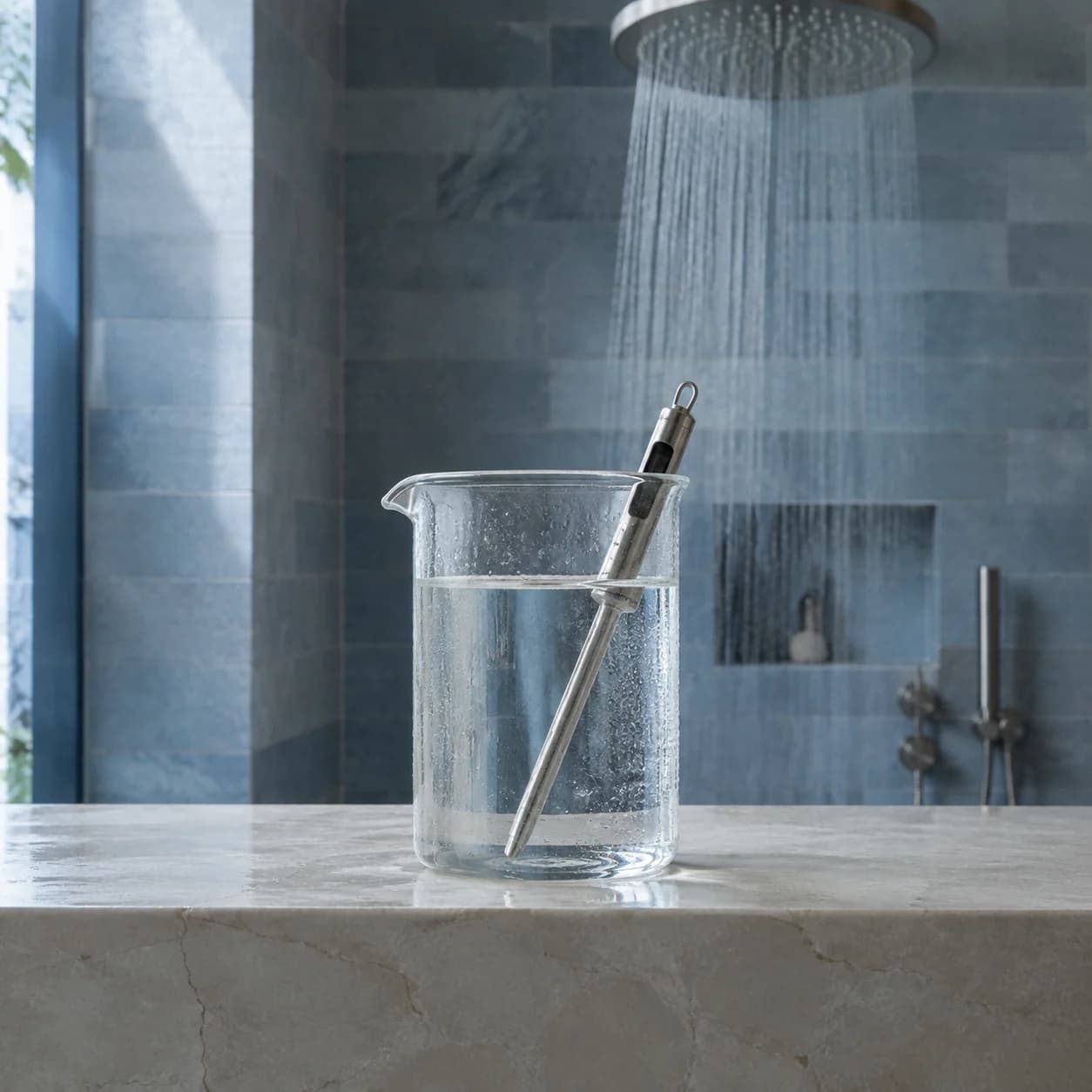
For a practical check, use a thermometer designed to measure water across the expected temperature range. Follow its instructions for immersion, response time and handling.
- Use the normal operating setup. Keep the intended shower head, hose and flow setting in place. Allow the system to complete its normal cooling and start-up process.
- Measure delivered water. Where the thermometer instructions allow it, collect a fresh sample from the running head in a clean, non-breakable container and measure promptly. Keep electrical parts that are not waterproof away from the spray.
- Allow the reading to settle. Follow the thermometer's response time and required probe depth. A reading taken while the probe is still changing temperature can be misleading.
- Repeat under the same conditions. A second fresh sample can help reveal whether the reading is stable. Note the flow setting and whether you measured immediately after starting or later in the run.
This is a household check, not a calibration certificate. The container, timing and thermometer accuracy can affect the result. If the outlet reading repeatedly differs from the display, check the manual for the sensor location and expected behaviour rather than assuming a universal acceptable difference.
What if your cold tap never reaches 15°C?
Measure it before deciding what you need. Cold tap water changes with the supply, season, pipework and building storage. The coldest handle position does not identify one temperature everywhere.
The water-temperature calculator provides an estimate to help you understand the local context. A measurement from your own shower is more useful when choosing settings or comparing equipment.
An actively cooled ice shower can reduce dependence on the incoming water temperature, within the system's operating limits. That is a practical distinction in warm conditions. It does not mean water above 15°C has no value, or that refrigeration guarantees a health benefit.
When comparing home ice shower systems, ask about the usable range and the delivered temperature at the intended flow. The lowest number on the specification sheet tells only part of the story.
Common questions about ice shower temperature
You do not need to go below 15°C simply to make the shower count. That temperature appears in cold-water research, but it is not an established minimum for benefits or a safe starting point for everyone. An ice shower is defined here by active cooling and temperature control, not by passing a single numerical threshold.
A 5°C setting delivers colder water, assuming both figures describe the actual outlet temperature. It does not establish a greater health benefit. The studies discussed in this guide do not provide a direct comparison showing that 5°C refrigerated showers improve health more than 10°C showers.
No. Near-freezing capability is a feature of some cooling equipment, not a temperature you need to use. Do not treat 1°C as a goal or assume that familiarity with cold showers makes it suitable. The name ice shower does not require ice to form or fall from the shower head.
There is no validated conversion that makes one shower temperature and duration equivalent to another. Ten minutes at one setting cannot be assumed to replace one minute at a colder setting. Flow, coverage and individual responses also matter; do not extend exposure to chase an imagined equivalent dose.
The display may show a selected target or a sensor elsewhere in the system rather than water at the outlet. Flow, spray coverage, standing position and whether you have just had a warm shower can also affect the experience. Check what the display represents and compare actual outlet readings under the same operating conditions.
Choose a setting you can use without chasing the minimum
Use 10–15°C to understand common research discussions, rather than as an instruction to start there. Begin gently if you are new to cold, check the water actually delivered and account for the time and coverage as well as the number on the display.
An ice shower gives you a choice of temperature. Making that choice does not require working down to the coldest one.
Ice showers
How Long Should an Ice Shower Be?
Put common cold-shower timings in context, account for temperature and coverage, and know when to end a session.

Ice showers
Ice Shower Benefits: Are Ice Showers Good for You?
Explore what the research says about alertness, mood, immunity and recovery, and where the evidence for ice showers stops.